Wednesday, August 4, 2010

Downlaod Ragnarok Emblem

The legacy of the Khmer Rouge

Skulls of Khmer Rouge victims at the Killing Fields memorial near Phnom Penh , written by Elizabeth Becker, Washington Post, one of the few Western journalists to have remained in Cambodia when the Khmer Rouge took power. (Interesting: The story chronicles the events from the perspective of a banker who studied Cambodian Laval University and McGill in the 60s).
We stayed only ten days in Cambodia (from this journey, our stay shorter in a country). So I can not say much about this country, especially since we had little contact with Cambodians, also employees of hotels, restaurants and taxi drivers. We knew we were visiting a country shattered by decades of war and the Khmer Rouge, by ending the war and expelling foreigners outside their borders, had plunged Cambodia into a nightmare more terrifying than anything the locals had endured before.
Four months (already!) after be passed, I'm reading a fascinating book on the history of Cambodia, which attempts to explain how the Khmer Rouge were able to seize power and impose their "revolution" to their fellow communist, with the "collateral damage" the elimination of 25% of the population (two million people !!!). If you're interested, the book is titled When The War Was Over
We learn that upon their arrival in 1975, the communists have radicals literally emptied the capital, Phnom Penh, in 24 hours (still two million inhabitants at the time). All citizens, including 20 000 hospital patients, were sent on foot into the countryside to cultivate the land - the goal of the Khmer Rouge was the sufficiency of Cambodia. Elites, opponents, intellectuals, or those suspected of being, were eliminated without further ado. The Communists have closed all shops, schools, abolished all laws, money (!), Private property, individual rights, religion, hobbies, and even the family - the peasants were organized into "cooperatives" and children separated from parents. Reading and writing were banned, like jewels, and the peasants were not to wear the "pajamas" prescribed by the new black dictators. Communist leaders were arranging marriages, decided who would be entitled to drugs and how much rice would be distributed (rice and nothing else ...). Every night, cooperatives, people disappear without anyone knowing why, and what happened to them (in most cases they were exterminated). And it lasted four years before the Vietnamese, Cambodians enemies, not just to end the bloody madness of Pol Pot and his forces.
When we visited the Tuol Sleng prison - the torture center of the Khmer Rouge - and the Killing Fields near Phnom Penh, we were shocked to learn the extent of the violence that the Cambodians have been submitted . (Read about a previous text,
The Khmer Rouge were driven from power in 1979, but fought in the bush for all the 80, which continued to undermine the country (in every sense of the term ...). A crowd of strangers have volunteered to help put the country back on track. Cambodia deployed what is the largest UN operation. This also gives rise to trafficking and abuse of all kinds. Cambodia is still one of the most corrupt countries in the world. We see more Lexus, Mercedes and Land Rover sparkling than any other Asian countries. A friend who is familiar with this environment we talked about some "humanitarian" who take advantage of a position in this country of misery to line their pockets and take it easy. Despite the millions of $ spent, Cambodia has a hard time coping. And many Cambodians are defeatists. "You know, they killed all the intellectuals 30 years ago, we said one of them, to try to explain why they are so poor ... How sad that a country so broken!


documented torture at the Tuol Sleng prison.


Sunday, July 25, 2010

Natural Blood Pressure Remedies Post A Comment

Learning to read by visiting Asia


Although Marianne knew already read when we left Montreal, she had improved by reading as possible. In addition to school supplies, crayons and some small toys we had brought books and magazines thin Pomme d'Api (Oh it was heavy and all that!). But Marianne is quickly passed through, and it was not very exciting to read the same stories again and again. In the first countries we visited (Thailand, Nepal, Burma), it was useless to look for children's books in French. But in Vietnam, due to colonial history, we found bookstores selling books in French (in Hanoi, Trang Tien street on the near the French Cultural Centre, and Saigon, Fahas bookshop on Dong Khoi Street ). Especially in Saigon, the French section for children was impressive. We did the full (albeit a bit expensive for our budget). Then at the end of the journey in Kunming, China, we found a great bookstore (Mandarin Books, near the university) that sold traditional Chinese story books translated into French, with superb illustrations, for about $ 2 each. We have made provisions and have brought a gift.
We tried to visit the library of the French cultural center in Hanoi, but it was closed for the Tet holiday. A French friend we visited in Phnom Penh suggested we visit the French cultural center in this city. There was a beautiful library, with a large section for children. It has even been able to see a film for children in French, a Saturday morning. In Laos, we also visited two French cultural centers in Vientiane (where there was also a cafe nice) and Luang Prabang (very small ...). The girls gave it to their heart in the new books. Vive la France (and their colonial past)!
We met in Kunming, a French family with two children, a cafe owner. We sympathize, and they will be loaned several books and magazines I read that we carried during our tour a month in Yunnan Province. These innovations have been very popular with girls.
But it explains in part why it is difficult to travel light with children, even when they no longer need to stroller or layers ...


Good reads the French Cultural Centre in Phnom Penh


Possible To Undo Software Update Sims 3

The traveling school


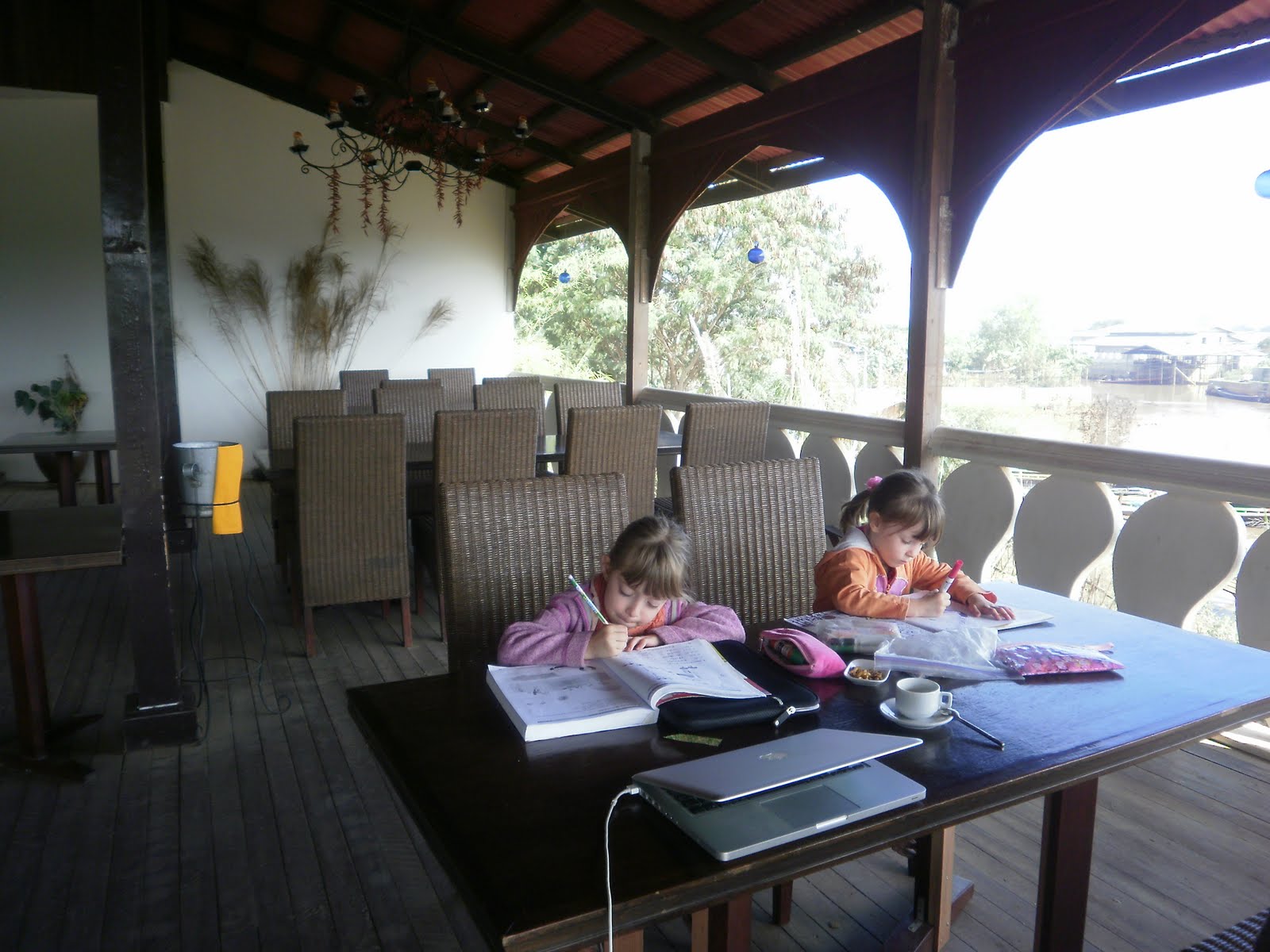
Marianne was in grade when we left Montreal to begin our journey to Asia in October 2009. The curriculum and workbooks weighed down our backpacks, but were essential for our daughter to continue her academic learning with us, his parents, as teachers.
We were lucky: our big girl had learned to read in kindergarten and was a little ahead of his group in reading, her teacher told us at the time of departure (this said with a big advanced maternal pride). But it was still work the math, expand their vocabulary and not lose the habit of doing homework regularly.

Teacher Playing on the road is not easy. We do not have the same relationship of authority with our own child can be a teacher. We do not control either the teaching techniques. But above all, on a trip, our schedule is constantly changing and we have no routine in which to insert the period of school work. Marianne thus regularly spent several days without opening its books when we were traveling or hiking. On average, I estimate that she worked three or four hours per week. There were some difficult times during which he was raising his voice to convince her to concentrate on his duties. Why sit in some hard thinking when there is the beach side, or play with friends, or exploring the mountains? During the second half of the trip, fortunately, Marianne realized she would be spared and it was better not to focus on to finish homework faster, then go have fun.

To help us, we were fortunate to have the support of Prof. Marianne Claude Martel, the international program at Saint Bartholomew. He gave us the material before the start and we were in contact with him throughout the journey. Marianne has even talked to his friends in the class a few times with Skype. The low power of Internet connections, however, prevented us from "Skype" as often as we wanted. We have answered some questions from his friends in the class via email and have sent pictures a few times.


Marianne returned to school for the last six days of classes in June. His teacher was able to verify that she had not fallen behind on other students. In fact, it appears to have rather taken the lead: unknowingly, we made him do exercises 2
e
year! There may be still some small adjustments to make next year for subjects on which we spent a little too quickly.
But even if she had taken a little late, I am convinced that the trip was for Marianne - and Emily! - An experience infinitely richer than a year in class (although having said that I believe in the importance of school ...). What they have learned will serve them throughout their lives. They have discovered other ways of living, other ways of thinking, other ways of eating, other ways to get around. They learned about the geography, history, politics, art, religion. They met people of all colors. And most importantly, I hope they realize how much they were favored above all poor and uneducated that we have crossed.


Not funny when the duties are following us on a journey ...


In Burma (Lake Inle)


Nepal (Pokhara)

In Vietnam (Paradise Resort)


In Laos (Luang Prabang - homework overlooking the Mekong)

Wednesday, June 30, 2010

Olay Generis Vs Garnier

Farewell to Vietnam

We finished our long stay (two months!) in Vietnam in the Mekong Delta, the region in the extreme south of the country where the great river, which originates in the glaciers of the Himalayas, flows into the South China Sea via multiple ramifications.
The region is crisscrossed by canals used by the population to move. In fact, people are literally living on the canals, in houses on stilts or in houseboats. We traveled in small or large boats on the canals, and visited the picturesque floating markets in the region.

People live on stilts over the water ...


... or just plain water, in houseboats.


The snake out to tourists.


After three days in the corner (Can Tho and Chau Doc), we left Vietnam in the Mekong River back to Phnom Penh, Cambodia. On our beautiful wooden boat, we passed the time chatting with a nice "granny" French, who drew with girls. For a couple of border formalities and presto! we changed countries. The head of the cruise we were led to believe that we of the crap at the border because we could not find the famous "map out" who we had been given to our arrival (we were supposed to keep it two months? No idea where it was picked up ...). Finally, it cost us a big $ 12 more for the Vietnamese leave us out of their homes. Fortunately, the visa for Cambodia was the cheapest of all the countries we visited ($ 60 for the whole family, compared $ 240 for Vietnam!).
After two months in Vietnam, we were not averse to a change of scenery. We saw beautiful places, met interesting people, but we also had some time to discover through this country and its inhabitants, which we liked less (see among others
this post and the

it, about the traffic). Our stay was not an easy one, but definitely rewarding.

floating market near Can Tho


Meat? Fish?


Pineapple?

Dragon Fruit! Our favorites!

Marianne and Emily are still receiving gifts: woven banana leaves.


Marianne fail to bite into the jackfruit with his teeth in less ... Lotus flowers


The most hilarious scene we've seen. When we take their animals for children ...

We left Chau Doc by this curious vehicle to catch the boat


Beautiful meeting on boat to Cambodia